
SEND
West Monkton C of E Primary School is an inclusive school where all pupils are supported. All Somerset maintained schools have a similar approach to meeting the needs of pupils with Special Educational Needs & Disabilities and are supported by the Local Authority to ensure that all pupils, regardless of their specific needs, make the best possible progress in school.
Somerset Local Offer
The Local Offer provides information on the services available for children and young people with Special Educational Needs and Disabilities (SEND) aged between 0 to 25 and how to access them.

For SEND Policy and Accessibility Plans, please see below.
SEND Information Report for Parents & Carers
Introduction & Aim:
The aim of this SEND Information Report is to explain how we implement our SEND policy. In other words, we want to show you how special educational needs support works in our school. The SEND Information Report is reviewed annually – the next review date is: June 2027.
If you want to know more about our arrangements for SEND, read our SEND policy.
You can ask a member of staff to send you a copy of the policy.
Note: If there are any terms we’ve used in this information report that you’re unsure of, you can look them up in the Glossary at the end of the report.
What types of SEN does the school provide for?
|
Area of need: |
Description: |
|
Cognition and Learning |
This area relates to children who have learning difficulties, meaning they may find it harder to process and understand information. This can include specific learning difficulties like dyslexia (difficulty reading and writing), dyscalculia (difficulty with numbers), or more general processing or memory difficulties. |
|
Communication and Interaction |
This broad area of need related to children who have difficulties with speaking, understanding others, or socialising. They might find it hard to express themselves clearly, understand language, or interact with other children or adults in social settings. |
|
Social, Emotional and Mental Health (SEMH)
|
Children with SEMH needs might experience emotional difficulties or behavioural challenges. They may struggle with regulating their emotions, coping with stress, or managing relationships with others. |
|
Sensory and/or physical |
This area includes children with physical disabilities or sensory impairments, such as difficulty seeing or hearing. It can also include children who have needs relating to movement, coordination, or require extra support to manage daily tasks. |
Which staff will support my child, and what training have they had?
The SENCos at West Monkton CE Primary School are: Mrs. Kate Prinn and Mrs. Carly Anderson. Mrs. Prinn and Mrs. Anderson both hold bachelor’s degrees, ‘qualified teacher status’ (QTS), and the National Award for SEND Coordination (NASEND).
Mrs. Prinn and Mrs. Anderson are supported by our Trust Pastoral Lead: Polly Skene, our Trust SEND Team Lead: Helen Newstead, and Bella Gibson (SENCo Support Assistant).
You can contact the SENCO at West Monkton CE Primary School by:
Telephone: 01823 412582
Email: office@wm.oak.education
Class Teachers:
All our teachers hold bachelor’s degrees and ‘qualified teacher status’(QTS). To meet the needs of children with SEND, teachers receive SEND training and are supported by the Trust SENCos, Senior Leaders from the school and Trust, and a wide range of external agencies and professionals,
Teaching Assistants (TAs):
We have a team of 23, including 2 higher-level teaching assistants (HLTA)s who are trained to deliver provision for children with SEND.
We have several teaching assistants who are trained to deliver interventions such as:
|
Teaching Assistants: |
Intervention Training: |
|
JP VB |
ELSA |
|
JP VB JL |
Block Therapy |
|
Key Staff |
Gastrostomy Care
|
|
Key Staff |
Diabetes Care
|
|
Key Staff |
Epilepsy Care
|
|
Key Staff |
Precision Teaching
|
|
Key Staff
|
Sensory Circuits |
|
Key Staff |
Supporting Children with Speech, Language and Communication Needs
|
|
Key Staff |
Supporting children who have experienced trauma
|
External Agencies and Professionals:
Sometimes we need extra help to offer the children at our school the support they need. Whenever necessary we will work with external support services to meet the needs of children with SEND and to support their families. These include:
- Speech and Language Therapists
- Educational Psychologists
- Assistant Educational Psychologists
- Somerset Inclusion Helpline Advisors
- Inclusion Team: Advisory Teachers
- Somerset Vision Team: Advisory Teachers
- Somerset Hearing Team: Advisory Teachers
- Occupational Therapists
- GPs or Paediatricians
- School Nurses
- Health Visitors
- Taunton Deane Partnership College: Specialist Social, Emotional and Mental Health Support: Advisory Teachers, HLTAs,
- Alternative Provision, such as: Otterhead Forest School, Player Ready and Conquest Equestrian Centre
- Selworthy Special School
- Play Therapists
- SASP: Mentor Scheme
- Family Intervention Service (FIS)
- Child and adolescent mental health services (CAMHS)
- Education Safeguarding Officers
- Social Services and other Local Authority (LA)-provided support services
- Physiotherapists
- Specialist Nurses: Diabetes and Gastrostomy Care
- Josephine’s Star: Specialist Bereavement Support
- Voluntary Sector Organisations
- Safe Families
- Link LDA: Somerset Key Worker Service
- Route 1: Child Advocates
- Young Somerset
- Somerset Parent Carer Forum
What should I do if I think my child has SEND?
Step 1: If you think your child might have SEND, the first thing you should do is tell their class teacher (you can also contact the SENCo directly). You can contact your child’s class teacher, or the SENCo, by:
Tel: 01823 412582
Email: office@wm.oak.education
|
Step |
Who it will involve: |
What they will do: |
|
2. Assess Plan |
Child Parent / Carer Class Teacher (SENCo) |
Your child’s Class Teacher will arrange to meet with you to discuss your concerns and try to get a better understanding of what your child’s strengths and needs are. They will then work with you, and your child to:
The Class Teacher will ask for help and support from the SENCo as necessary. Your child’s teacher will make a note of what’s been discussed in your child’s record. |
|
3. Do |
Child Parent / Carer Class Teacher (SENCo) |
Your child’s class teacher will then work with you, and your child, to support them to achieve the outcomes agreed at the meeting. If needed, the class teacher can seek additional help / advice from the other teachers in the school, or the SENCo.
|
|
4. Review |
Child Parent / Carer Class Teacher SENCo |
After this, your child’s Class Teacher will work with you and your child to review their progress towards the agreed outcomes. At this point, your child’s class teacher may recommend that they contact the SENCo for further advice and support.
|
|
5. Assess Plan |
Child Parent / Carer Class Teacher SENCo |
The SENCo will then work with you, your child, and their Class Teacher to find out a little more about your child’s strengths and needs. Together, you will agree the next outcomes for your child and the provision necessary to achieve those outcomes. The SENCo will make a note of what’s been discussed in your child’s record. |
|
6. Do |
Child Parent / Carer Class Teacher SENCo |
Your child’s class teacher will then work with you to support your child to achieve the outcomes identified in the meeting. If needed, the class teacher can seek additional help / advice from the other teachers in the school, or the SENCo.
|
|
7. Review |
Child Parent / Carer Class Teacher SENCo |
After this, in discussion with you and your child, your child’s class teacher will review progress towards achieveing the agreed outcomes. You will work together to agree next steps in supporting your child.
|
If, together, we decide that your child needs ‘SEND Support’ we will ask your consent to add their name to the school’s SEND register.
SEND Support is the extra help and resources provided to children with Special Educational Needs and Disabilities (SEND) to help them succeed. This support is personalised to meet each child's needs. It can include things like:
- Special teaching strategies or resources (like extra time on tasks or visual aids)
- Intervention support from teaching assistants or external professionals / agencies (such as Speech Therapists or ELSAs)
- Adjustments in the classroom, like quieter spaces or different ways of learning
The goal of SEND Support is to ensure that every child, regardless of their SEND needs, has the opportunity to learn, grow, and reach their full potential.
The SEND Register is a list that schools keep of all the children who have Special Educational Needs and Disabilities (SEND). It helps teachers, the SENCo, and Senior Leaders, keep track of which children need extra support or adjustments in their learning. It helps to make sure that children with specific needs get the right kind of help and support. The SEND register helps everyone involved in the child’s education stay organised and focused on giving the best support possible.
How will the school know if my child needs SEN support?
All our class teachers have training in SEND and are on the lookout for any pupils who aren’t making the expected level of progress in their development in any of the four broad areas of need (see above). This might include: difficulties with learning, struggling with friendships or managing emotions, difficulties hearing / seeing, or difficulties with sensory processing.
If a teacher notices that a child is struggling to make progress, they try to find out if the child has any gaps in their learning or development. If they can find a gap, they will give the child extra support to try to fill it. Children who don’t have SEND usually make progress quickly once the gap in their learning or development has been filled.
If, after some extra support, the child is still struggling to make the expected progress, the teacher will talk to the SENCo. They will also contact you to discuss your child’s strengths and needs and how we can work together to support them to make progress.
The SENCo may do the following things to help them find out a little more about your child’s strengths and needs and how best to support them:
- Talk to the child
- Observe them in class or on the playground
- Look at their work in class
- Do some assessments
- Look at your child’s progress and development overtime in relation to their peers and available national data
- With your agreement, ask for advice from external agencies / professionals – e.g. Occupational Therapists / Advisory Teachers etc.
Based on all of this information, the SENCO, in discussion with you and your child’s class teacher, will decide whether your child needs SEND support (see above).
If your child does need SEND support, with your consent, their name will be added to the school’s SEND Register (see above). Your child’s class teacher will work with you, your child, and the SENCo, to create an ‘Individual Education Plan (IEP),’ and ‘Adaptations Passport,’ to support your child at school.
How will the school measure my child's progress?
We will follow the ‘graduated approach’ to meeting your child’s SEN needs. The graduated approach is a 4-part cycle of: assess, plan, do, review (APDR).
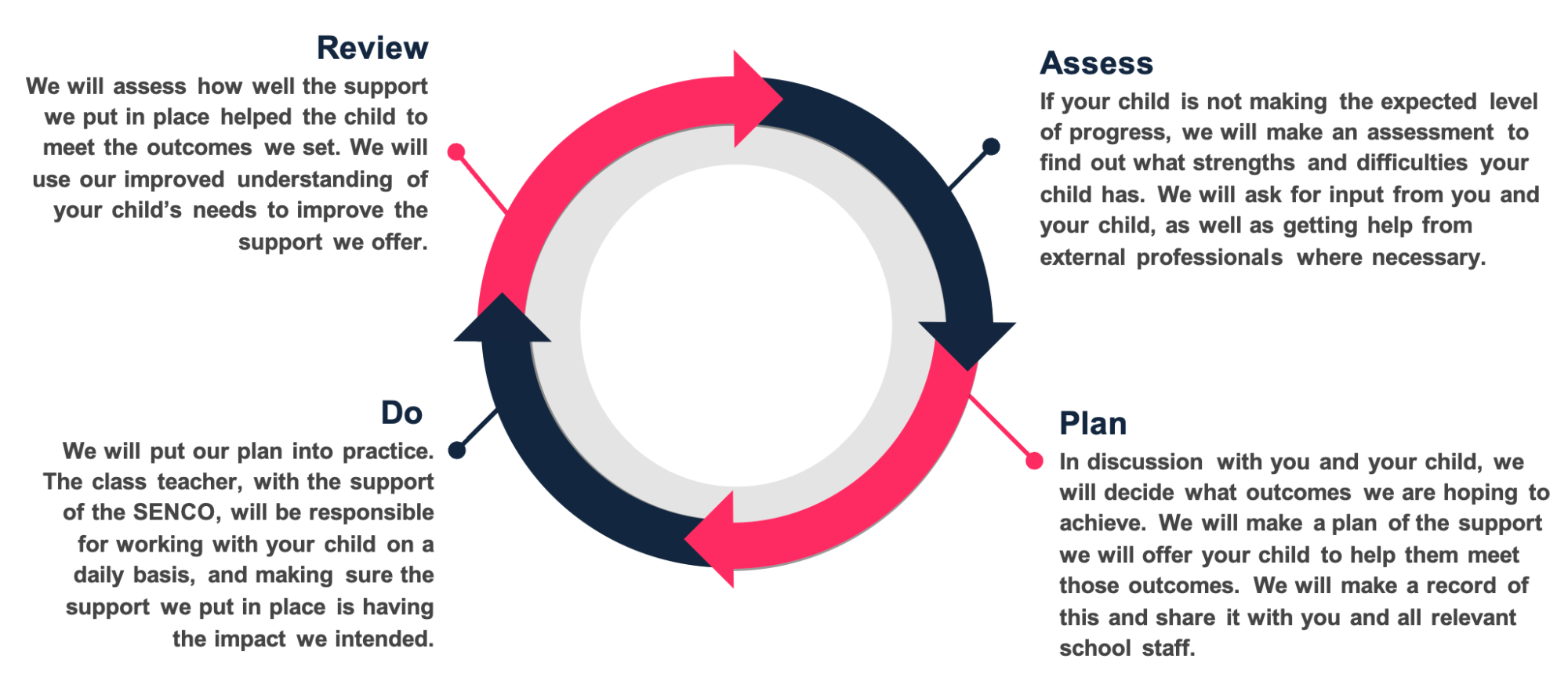
The graduated approach starts with an assessment of your child’s strengths and needs. We can then use the assessment information to ‘plan’ next steps. We will work with you and your child to decide which outcomes we would like your child to work towards and how we will support them to achieve those outcomes.
Whenever we ‘do’ an intervention with your child, we will assess them at the start and end of the intervention. We do this so we can see how much impact the intervention has on your child’s progress. During the ‘do’ phase of the graduated response, we will track your child’s progress towards the outcomes we set over time. We will change, and improve, our support offer, as we learn what best supports your child to achieve the outcomes set at the ‘plan’ stage.
At the end of the ‘do’ phase, your child’s progress towards the outcomes set will be ‘reviewed’.
After the ‘review’ the graduated response (assess-plan-do-review) begins again. This process is continual. If the ‘review’ shows a pupil has made progress, they may no longer need the additional provision made through SEND support. For others, the cycle will continue and the outcomes, strategies and provisions will be revisited and refined over-time.
How will I be involved in decisions made about my child's education?
We know that you’re the expert when it comes to your child’s strengths, needs, and aspirations, and how best to help them. The Special Educational Needs and Disabilities Code of Practice (DfE: 2015) sets out the central role that you, and your child, should have in making decisions about their education. We value your insight into the best ways to support your child at home and school and want to make sure you have a full understanding of how we’re trying to meet your child’s needs.
We want to hear from you as much as possible, so that we can build a picture of how the SEND support we are providing is impacting your child outside of school. If your child’s strengths, needs, or aspirations, change at any time, please let us know right away so we can keep our provision as relevant as possible.
After any discussion we will make a record of any outcomes, actions and support that have been agreed. This record will be shared with all relevant staff.
If you have concerns that arise between contacts, please contact your child’s class teacher, or the SENCo:
Tel: 01823 412582
Email: office@wm.oak.education
Class teachers will provide an annual report on your child’s progress. In addition, your child’s class teacher will meet with you at least twice a year, at parent / carer consultation evenings, to:
- Set clear outcomes for your child’s progress
- Review progress towards those outcomes
- Discuss the support we will put in place to help your child make progress
- Identify what we will do, what we will ask you to do, and what we will ask your child to do
This will be recorded in your child’s ‘Individual Education Plan’ (IEP) and ‘Adaptations Passport’.
In addition, you can arrange to speak to / meet with your child’s class teacher, and / or the SENCo, at any time:
Tel: 01823 412582
Email: office@wm.oak.education
How will the school adapt its teaching for my child?
Your child’s class teacher is responsible, and accountable, for the progress and development of all the children in their class.
High-quality first teaching is always our first step in responding to your child’s needs. We will make sure that your child has access to a broad and balanced curriculum that is ‘adapted’ and ‘differentiated’ to meet their needs. We will change how we teach to suit the way your child learns best. There is no '1-size-fits-all’ approach to adapting, or differentiating, the curriculum for children with SEND. Teachers work on a case-by-case basis to make sure the adaptations, and / or differentiations, they make are effective for your child.
Our Accessibility Plan sets out how we are continually working to improve access to all aspects of school life for children with SEND.
Adaptations may include:
- Differentiating our curriculum to make sure all children are able to access it, for example, by grouping, 1-to-1 work, adapting the teaching style, content of the lesson, and / or resources etc.
- Differentiating our teaching, for example, giving longer processing times, pre-teaching of key vocabulary, reading instructions aloud, providing visuals etc.
- Adapting our resources and staffing
- Using recommended resources, such as laptops, coloured overlays, visual timetables, larger font, etc.
- Teaching assistants will support children 1:1, in small-groups, and as part of a whole class.
The school may also provide the following research-based interventions:
|
Name of Intervention |
Purpose of Intervention |
|
Nessy Intervention: Nessy Reading and Spelling (Age: 6-11) |
Individualised, highly-structured, sequential, cumulative and systematic, phonics-based learning program that progresses to fluency.
|
|
Nessy Intervention: Nessy Hairy Reading (Ages: 4-6) |
Individualised, structured phonics reading program with decodable books. |
|
Colourful Semantics
|
This is a research-based, visual way to help children improve their language skills, especially when it comes to forming sentences and understanding how words work together. This can be especially helpful for children who have difficulty with speaking or understanding language. |
|
Block Therapy |
Block Therapy is designed to support children to develop skills in social communication and interaction.
|
|
Emotional Literacy Support Assistant (ELSA) |
ELSAs work to help children recognise, and name, their emotions. They also help children to develop strategies to manage their emotions.
|
|
Socially Speaking |
Socially Speaking is a programme that helps pupils with mild to moderate learning disabilities improve their social interaction skills. |
|
Friendship Matters |
Friendship Matters is an intervention program designed specifically to help girls improve their social skills and build strong, positive friendships. It focuses on teaching girls how to communicate effectively, manage conflicts, and understand each other's feelings. |
These interventions are part of our contribution to Somerset’s local offer. You can explore Somerset’s Local Offer for children with SEND here: Somerset’s SEND Local Offer
How will the school evaluate whether the support in place is helping my child?
We will evaluate the effectiveness of provision for your child through:
- Reviewing their progress towards the outcomes set out on their IEP each term
- Reviewing the impact of interventions through ‘start’ and ‘end’ data
- Talking to you, and your child, about how effective you feel the support has been
- Using pupil questionnaires
- Monitoring by the SENCO / Senior Leaders
- Completing assessment / screening tests
- Use of standardised assessments.
- Observations by the SENCo / Senior Leaders / Class Teacher
- Feedback from TAs
- Feedback from external agencies and pro
- Holding an annual review (if they have an education, health and care plan (EHCP).
How will the school resources be secured for my child?
It may be that your child’s needs mean we need to secure:
- Extra equipment or facilities
- More teaching assistant hours
- Further training for our staff
- External specialist expertise
If that’s the case, we will consult with external agencies and professionals to get recommendations on what will best help your child access their learning.
If your child has an EHCP, the Local Authority will allocate additional ‘High Needs Funding’ to facilitate the provision set out in Section F of their EHCP.
How will the school make sure my child is included in activities alongside pupils who don't have SEND?
All children are encouraged to take part in every aspect of school life. No child is ever excluded from taking part in activities because of their SEND needs and we will make whatever reasonable adjustments are needed to make sure they are included.
How does the school make sure that the admissions process is fair for pupils with SEN or a disability?
We follow Statutory Guidance: Schools must comply with the statutory guidance on Fair Access Protocols, which is set out in the School Admissions Code 2021.
We are supported and Informed: Local authorities are required to provide impartial information, advice, and support for children, young people, and parents on SEN and disability issues, including admissions.
These steps help ensure that all children, including those with SEN or disabilities, have the opportunity to attend a suitable school that meets their individual needs.
How does the school support pupils with disabilities?
We work continually to improve our support for children with disabilities. More information about this can be found in the school’s Accessibility Plan, here: Policies | The Oak Partnership Trust
How will the school support my child's mental health, and emotional and social development?
We recognise that children’s social, emotional and mental health and wellbeing is vital if they are going to achieve positive outcomes in education and into adulthood. We provide support for children to progress in their emotional and social development in the following ways:
- Trauma-informed ‘Behaviour Policy’ that recognises that all behaviour is a form of communication.
- Teachers and TAs are trained, and experienced in using emotion-coaching and a PACE approach to supporting children’s social, emotional and mental health and development.
We provide extra pastoral support for listening to the views of pupils with SEND.
We have a ‘zero tolerance’ approach to bullying. We prevent bullying in the school by;
- Encouraging positive relationships, kindness, and pupil participation.
- Addressing root causes—e.g., prejudice‑based bullying related to race, disability and more.
- Providing clear channels for parents to report concerns.
- Providing pastoral support
- Recording any incidents and monitoring for patterns of behaviour.
- Educate children about Bullying both on and off line.
What support will be available for my child as they transition between classes or settings, or preparing for adulthood?
Between School Years:
To help pupils with SEND be prepared for a new school year we:
- Ask both the current teacher and the next year’s teacher to meet to discuss the SEND needs of any children in the class
- Schedule times with the incoming teacher towards the end of the summer term
- Teachers will pass on your child’s Passport and IEP to their new teacher
- Additional transition sessions
Between schools:
- When your child is moving on from our school, we will ask you and your child what information you want us to share with the new setting.
- The SENCo of the New/Secondary school meets with our SENCO to discuss the needs of the incoming pupils near the end of the summer term.
- Children with SEND may be offered a more personalised enhanced transition
- Parents/carers of incoming pupils may be invited to attend a meeting with the class teacher and / or SENCo
Starting School in EYFS:
- Before your child starts school, the SENCo will contact you, and your child’s nursery / pre-school, to find out about any SEND needs your child may have and how we can continue to support them when they start school.
- If your child has an EHCP, the school will arrange a ‘School Entry Planning Meeting’ with you, your child’s nursery / pre-school, and any other external agencies and professionals who are working with you and your child. At the meeting we will agree a ‘School Entry Plan’ to make sure that your child has the right support in place to help with starting school.
- The ‘School Entry Plan’ will be reviewed after the first ½ of the autumn term – or sooner of necessary.
What support is in place for looked-after and previously looked-after children with SEND?
Mrs. Abbie Paling the designated teacher for looked-after children and previously looked-after children at West Monkton CE Primary School.
Mrs. Paling will work with Kate Prinn and Carly Anderson, our SENCOs, to make sure that all teachers understand how a looked-after or previously looked-after pupil’s circumstances, and their SEND needs might interact, and what the implications are for teaching and learning.
Children who are looked-after or previously looked-after will be supported much in the same way as any other child who has SEND. However, looked-after pupils will also have a personal education plan (PEP). We will make sure that the PEP and any SEND support plans or EHC plans are consistent and complement one another.
What should I do if I have a complaint about my child's SEN support?
Complaints about SEND provision in our school should be made to the Class Teacher and Head Teacher in the first instance. They will then be referred to the school’s complaints policy.
If you are not satisfied with the school’s response, you can escalate the complaint. In some circumstances, this right also applies to the pupil themselves.
To see a full explanation of suitable avenues for complaint, see pages 246 and 247 of the SEND Code of Practice.
If you feel that our school has discriminated against your child because of their SEND, you have the right to make a discrimination claim to the first-tier SEND tribunal. To find out how to make such a claim, you should visit: https://www.gov.uk/complain-about-school/disability-discrimination
You can make a claim about alleged discrimination regarding:
- Admission
- Exclusion
- Provision of education and associated services
- Making reasonable adjustments, including the provision of auxiliary aids and services
Before going to a SEND tribunal, you can go through processes called disagreement resolution or mediation, where you try to resolve your disagreement before it reaches the tribunal.
Insert contact details of the disagreement resolution and mediation services for your local authority/ies here.
What support is available for me and my family?
If you have questions about SEND, or are struggling to cope, please get in touch to let us know. We want to support you, your child, and your family.
To see what support is available to you locally, have a look at the local offer. Somerset publishes information about the local offer on their website: Somerset’s SEND Local Offer
Our local special educational needs and disabilities information, advice and support (SENDIAS) services are: Somerset SENDIAS
Local charities that offer information and support to families of children with SEN are:
Somerset Parent Carer Forum CIC Ltd (not for profit) company no. 10227489
Brainwave – Unlocking Children's Potential
The Den Coffee House – Chatty Cafe Scheme UK
National charities that offer information and support to families of children with SEN are:
Glossary
Access arrangements – special arrangements to allow pupils with SEN to access assessments or exams
Annual review – an annual meeting to review the provision in a pupil’s EHC plan
Area of need – the 4 areas of need describe different types of needs a pupil with SEN can have. The 4 areas are communication and interaction; cognition and learning; physical and/or sensory; and social, emotional and mental health needs
CAMHS – child and adolescent mental health services
Differentiation – when teachers adapt how they teach in response to a pupil’s needs
EHC needs assessment – the needs assessment is the first step on the way to securing an EHC plan. The local authority will do an assessment to decide whether a child needs an EHC plan
EHC plan – an education, health and care (EHC) plan is a legally-binding document that sets out a child’s needs and the provision that will be put in place to meet their needs
First-tier tribunal / SEND tribunal – a court where you can appeal against the local authority’s decisions about EHC needs assessments or plans and against discrimination by a school or local authority due to SEN
Graduated approach – an approach to providing SEN support in which the school provides support in successive cycles of assessing the pupil’s needs, planning the provision, implementing the plan, and reviewing the impact of the action on the pupil
Intervention – a short-term, targeted approach to teaching a pupil with a specific outcome in mind
Local offer – information provided by the local authority that explains what services and support are on offer for pupils with SEN in the local area
Outcome – target for improvement for pupils with SEN. These targets don't necessarily have to be related to academic attainment
Reasonable adjustments – changes that the school must make to remove or reduce any disadvantages caused by a child’s disability
SENCO – the special educational needs co-ordinator
SEN – special educational needs
SEND – special educational needs and disabilities
SEND Code of Practice – the statutory guidance that schools must follow to support children with SEND
SEN information report – a report that schools must publish on their website, that explains how the school supports pupils with SEN
SEN support – special educational provision that meets the needs of pupils with SEN
Transition – when a pupil moves between years, phases, schools or institutions or life stages