CLL


The Leaders for the Communication, Language & Literacy (CLL) Domain are Leanne Ward (KS2) and Paige Merrick (EYFS & KS1).
The CLL policy is available on the policies page.
The Teaching of Early Reading
Phonics
EYFS/KS1:
At West Monkton we use Read Write Inc. Phonics (RWI) to teach children to read and write. Read Write Inc. is a systematic synthetic phonics programme that gives children the knowledge and skills they need to become confident and fluent readers, as well as supporting with their writing development.
Children are taught the sounds that letters and groups of letters make. They learn these sounds systematically and practise them regularly so that they become secure and automatic. Once children know a sound, they learn to blend sounds together to read words. For example, they might learn to say the individual sounds in c-a-t and then blend them together to read cat. Children practise this using the Read Write Inc. approach of 'Fred Talk'. As children progress, they learn more complex sounds and letter combinations, allowing them to read increasingly challenging words and sentences.
An important part of Read Write Inc. is that children read books that are carefully matched to the sounds they have been taught. This means that children can practise the skills they have learnt and experience the success of reading books for themselves. Children develop their reading fluency by reading and re-reading familiar texts, helping them to move from sounding out words to reading them confidently and smoothly.
Read Write Inc. brings reading and writing together. Children practise spelling the words they can read and learn to write the sounds and words they have been taught. They also develop their vocabulary, sentence construction and understanding through discussion about the texts they read. Talk is an important part of every lesson. Children have opportunities to discuss their ideas with their partners and teachers, helping them to develop their spoken language and understanding.
Children are regularly assessed so that teaching can be carefully matched to their current phonics knowledge. This enables children to practise at an appropriate level and ensures that children who need additional support can receive it quickly. EYFS are taught as a whole-class initially before receiving their phonics teaching in smaller groups. The rest of KS1, and children in LKS2 who would still benefit from a Phonics input, are then grouped across the year groups; this enables us to teach children to the appropriate level and support good progress.
KS2:
Children in KS2, particularly in Years 3 and 4, will continue to be in RWI groups until their fluency and comprehension have reached a level where they no longer require additional phonics support. Children across KS2 will receive targeted phonics support in small groups where appropriate.
Reading
At West Monkton, we use the Scarborough Reading Rope model to underpin how we teach reading. This clearly demonstrates how the strands of 'Word Recognition' and Language Comprehension' are interwoven. We recognise that both decoding (the ability to translate written words into the sounds of spoken language) and comprehension (the ability to understand the meaning of the language being read) skills are necessary for confident and competent reading, but neither is sufficient on its own. At West Monkton, children will have a range of wider language and literacy experiences to develop their understanding of written texts in all their forms.
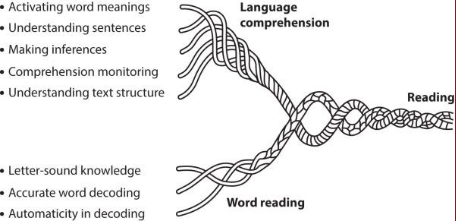
‘Reading Rope’ diagram from Peggy McCardle, Hollis S Scarborough and Hugh W Catts:
‘Predicting, Explaining and Preventing Children’s Reading Difficulties’,
Learning Disabilities Research & Practice 16:4 (2001)
Throughout our school, teachers use a high-quality book as a learning stimulus for every cross-curriculum unit. These texts are linked and enhance knowledge and understanding across different domains, particularly STEM and Place and Time. When working with the chosen texts, teachers use the objectives from National Curriculum 2014 and content domains developed by Somerset Literacy Network, which focus on prediction, understanding vocabulary, finding answers in the text, using inference and summarising key information.
Teaching focuses on developing pupil’s competence in word reading and comprehension to allow children to become confident readers, as demonstrated in the model above. The teaching of skills will vary between the two, this is carried out through small groups as well as whole class teaching of reading.
Whole Class Reading
Children are given opportunities to listen to, read, answer questions and comment on, books and stories during whole class sessions. These are based on high-quality/unit related texts. Teachers and pupils share the text, with the teacher modelling as an expert reader through questioning and supports pupils with drawing out the key elements of the content.
Group Reading
Group-reading sessions (word reading and comprehension) take place daily in KS1. In LKS2 (Y3& 4), pupils are in a small group with a teacher, this is a minimum of twice a half-term and once a half-term in UKS2 (Y5&6). This allows children to become embedded in a text, promotes a love of reading and builds on linguistic knowledge (in particular vocabulary and grammar). Teachers select texts that cover a range of reading genres that support and challenge children’s reading capabilities.
These small group reading sessions always follow the same principle:
1. Pre-reading of the text (independent or as a collective)
2. Group-led session, during which in depth discussion of the text place, such as detailed examination of the character, language and writing. As part of this process, children learn to use inference, prediction and justification skills.
3. Independent Comprehension, which allows children to think carefully about the text by answering comprehension questions linked to the reading objectives discussed in class.
Reading at Home
Reading at home is an important part of your child's progress. We encourage families to read regularly with their children and to talk about the books they are reading. Children in EYFS, KS1 and LKS2, may bring home books that are matched to the phonics they are learning in school, allowing them to practise their decoding and develop confidence and fluency, as well as an additional book band book which they won't have read in school that week.
Alongside phonics, we also value sharing a wide range of high-quality stories and books with children. Listening to stories, discussing books and developing a love of reading are all important parts of becoming a successful reader.
Our aim is for every child to develop the skills, confidence and enjoyment they need to become a lifelong reader.
In KS2, we are also using Oxford Reading Buddy. This is a digital reading service to develop comprehension and encourage a love of reading. It matches pupils with books at the right level and tracks performance across hundreds of Oxford’s print and digital books through expertly written comprehension quizzes. These assess the children’s understanding of a text to enable individual progression. Quiz results are reported back to teachers so that we can see where your child might need more help and support.